Altria (MO) Raises Dividend 4.7% to $1.11, Its 61st Increase in 57 Years
Altria (MO) lifted its quarterly dividend 4.7% to $1.11, extending a 57-year record as steady earnings growth supports another measured increase.
 MO — Altria Group, Inc.
Key takeaways
- Altria raised its quarterly dividend 4.7% to $1.11 from $1.06.
- The new $4.44 annual rate provides $444.00 of yearly income for every 100 shares if maintained.
- The 6.44% forward yield compares with a 3.21% Consumer Defensive sector median, while the earnings payout ratio is 89%.
- Altria calls this its 61st increase in 57 years; the uninterrupted current per-share growth streak is 17 years.
Altria Group, Inc. raised its regular quarterly dividend 4.7% to $1.11 a share from $1.06. The stock went ex-dividend on September 15, 2026, for a payment due October 9, 2026, to shareholders of record on September 15, 2026, according to the board's declaration. The action was a regular increase, not the result of a split, merger or spin-off.
Why the dividend changed
Altria gave a direct policy explanation. The board said the increase was consistent with its progressive dividend goal, which calls for recurring per-share growth. The 4.7% move therefore reflects an established capital-allocation policy rather than a response to a one-time asset sale or corporate transaction. The declaration also set the new annual rate at $4.44 a share and identified this as the company's 61st dividend increase in the past 57 years.
The operating backdrop supported another increase. In its latest results, Altria reported that second-quarter adjusted diluted earnings per share rose 2.8% and first-half adjusted diluted earnings per share rose 4.9%. It raised the lower end of full-year guidance and narrowed the expected range to $5.61 to $5.72, growth of 3.5% to 5.5% from $5.42 in 2025. Management said smokeable-product pricing and cigarette import and export activity helped offset lower volume, while macroeconomic pressure on nicotine consumers remained a constraint. Those results and assumptions are detailed in Altria's second-quarter release.
The same release shows why the dividend still depends heavily on the traditional tobacco franchise. Inventory-adjusted domestic cigarette shipment volume declined an estimated 4.5% in the quarter, but adjusted operating companies income in smokeable products rose 2.4% as pricing and tax-refund benefits outweighed volume and cost pressure. At the same time, Helix expanded on! PLUS nationally, while the guidance assumed NJOY ACE would not return to the market in 2026. The increase rests on earnings delivery from the core business while smoke-free products remain an investment program, not yet a full replacement for cigarettes.
Management's stated capital order reinforces that reading. Chief Financial Officer Heather Newman called the dividend Altria's “primary vehicle” for shareholder returns, with remaining cash considered for debt management, repurchases and possible acquisitions, during the latest earnings call. That makes the dividend the first claim in Altria's discretionary capital allocation, though each payment still requires board approval.
Dividend track record
The recent payment sequence shows a deliberate annual step-up. The quarterly rate was $1.02 on the March 25, 2025, and June 16, 2025, ex-dividend dates, then $1.06 beginning with September 15, 2025. It stayed at $1.06 through June 15, 2026, before moving to $1.11 on September 15, 2026. The pattern is one increase each year, followed by several equal quarterly payments, rather than frequent small adjustments.
Full-year totals tell the same story. Payments rose from $3.40 a share in 2020 to $3.52 in 2021, $3.68 in 2022, $3.84 in 2023, $4.00 in 2024 and $4.16 in 2025. The annual increases were 3.5%, 4.6%, 4.4%, 4.2% and 4.0%, respectively. The five-year annualised dividend growth rate was 4.1%, closely matching the latest 4.7% raise.
There are two valid but different records to understand. Altria says this was its 61st dividend increase in the past 57 years. The uninterrupted current per-share annual series is 17 years, and the last annual cut was in 2008. The shorter count reflects the 2008 corporate breakup, when Philip Morris International was separated and the current Altria per-share series reset. Coverage of the latest increase notes that Altria has raised the dividend each year since that breakup, while the company statement counts increase actions across its longer corporate history (Investing.com). The 2008 decline therefore coincided with a structural separation, not the current board reversing this year's increase.
Is the dividend covered?
The dividend uses 89% of earnings. That is a high payout ratio, so coverage depends on Altria preserving the earnings power of its tobacco portfolio. A payout at that level leaves less flexibility if profit falls, even though it is consistent with a business model that directs most earnings to shareholders.
SmarterDividends rates the dividend A, with a safety score of 80. The grade means “very safe” within the scoring range of 80-100. In plain terms, the record, current earnings coverage and repeatable payment pattern support a strong safety assessment despite the elevated earnings payout. The grade is not a guarantee. Altria itself states that future dividends remain at the board's discretion, and the latest outlook identifies consumer pressure, regulation, litigation and the absence of NJOY ACE from the market as continuing variables.
Yield and valuation
At a share price of $69.72, the $4.44 annual dividend produces a 6.44% forward yield. That compares with a 3.21% median forward yield for the Consumer Defensive sector. The spread shows that Altria offers substantially more current income than the broad sector benchmark, while the 89% earnings payout and cigarette-volume decline explain why the higher yield comes with distinct operating and regulatory exposure.
SmarterDividends estimates fair value at $101.21 and classifies the shares as undervalued, with 46% upside to fair value. The estimate is a valuation reference, not a price target or forecast. The shares have risen 23.3% over one year, so the valuation verdict coexists with a substantial recent gain rather than following a period of reported price weakness.
How Altria compares with peers
Altria's 6.44% forward yield is above British American Tobacco's 5.98% and Philip Morris International's 3.35%. All three yields exceed the 3.21% Consumer Defensive sector median, but their coverage and dividend records differ.
On a comparable uninterrupted per-share basis, Altria's 17 years of growth exceed Philip Morris International's 13 and British American Tobacco's 2. Altria's 89% earnings payout ratio is also higher than British American Tobacco's 85% and Philip Morris International's 81%. That combination gives Altria the highest current yield of the group and the least earnings headroom by the payout-ratio measure.
The safety grades add another distinction. SmarterDividends rates Altria A, Philip Morris International B and British American Tobacco C. These grades describe dividend safety, not business quality or expected share-price returns. Altria's longer current growth run and A grade offset some of the caution signaled by its higher payout ratio. The company's separate statement of 61 increases over 57 years should not be compared directly with the peers' consecutive-year figures because it uses a different historical convention.
What to watch
The next scheduled checkpoint is Altria's third-quarter earnings call on October 29, 2026, at 9:00 a.m. Eastern Time, according to its investor events calendar. The report will show whether adjusted earnings remain within the $5.61 to $5.72 full-year range that underpinned the board's confidence at the time of the increase.
Three operating items matter for coverage. First is the balance between cigarette pricing and volume as adult nicotine consumers remain under pressure. Second is the national rollout and planned product extensions for on! PLUS, which management is using to broaden the smoke-free portfolio. Third is NJOY ACE. Altria's guidance assumes the product does not return in 2026, while management has said it intends to re-enter the category at an unspecified time. The company is also investing in a smokeless-tobacco manufacturing consolidation, which raises capital spending but is expected to be funded from operations. Each item affects the earnings and cash-generation base behind future board decisions.
Payment details
The new regular quarterly dividend is $1.11 per share. It went ex-dividend on September 15, 2026, and the record date was September 15, 2026. The payment is due October 9, 2026, under the August 27 declaration.
At the new quarterly rate, the annual dividend is $4.44 per share. An investor holding 100 shares receives $444.00 a year if the rate remains unchanged and all four quarterly payments are made. To qualify for the October payment, shares had to be purchased before the September 15, 2026, ex-dividend date. A purchase on or after the ex-dividend date did not carry the right to that payment.
MO dividend data
From the SmarterDividends dataset, updated daily
- Forward yield
- 6.54%
- Payout ratio
- 89%
- Growth streak
- 17 yrs
- Safety grade
- A · 81/100
| Ex-dividend date | Amount | Change |
|---|---|---|
| Sep 15, 2026 | $1.1100 | +4.7% |
| Jun 15, 2026 | $1.0600 | +0.0% |
| Mar 25, 2026 | $1.0600 | +0.0% |
| Dec 26, 2025 | $1.0600 | +0.0% |
| Sep 15, 2025 | $1.0600 | +3.9% |
| Jun 16, 2025 | $1.0200 | +0.0% |
| Mar 25, 2025 | $1.0200 | +0.0% |
| Dec 26, 2024 | $1.0200 | +0.0% |
Frequently asked questions
How much is Altria's MO dividend now?
Altria's regular quarterly dividend is $1.11 per share, raised 4.7% from $1.06.
How much does MO pay in dividends per year?
The annual dividend is $4.44 per share. At that rate, 100 shares produce $444.00 in annual income if all four quarterly payments are made.
When was the MO ex-dividend date?
The $1.11 quarterly payment went ex-dividend on September 15, 2026.
When will Altria pay the new dividend?
Altria will pay the $1.11 dividend on October 9, 2026, to shareholders of record on September 15, 2026.
Is the MO dividend safe?
SmarterDividends rates the dividend A, with a safety score of 80, meaning very safe within the 80-100 range. The 89% earnings payout ratio nevertheless leaves less flexibility if earnings weaken.
How many years has Altria increased its dividend?
Altria says this is its 61st increase in the past 57 years. The uninterrupted current per-share annual growth streak is 17 years, following the 2008 corporate breakup.
What is MO's dividend yield, and how does it compare with peers?
MO's forward yield is 6.44%, versus 5.98% for British American Tobacco, 3.35% for Philip Morris International and a 3.21% Consumer Defensive sector median.
Why did Altria raise its dividend?
Altria said the 4.7% increase was consistent with its progressive dividend policy. The decision followed first-half adjusted earnings growth and a narrowed full-year earnings outlook.
Sources
See MO's full dividend profile
Yield, payout, safety score, history and the next ex-dividend date.
View MOEvery dividend increases this month, with the data behind it: Dividend Increases, September 2026.
More dividend news

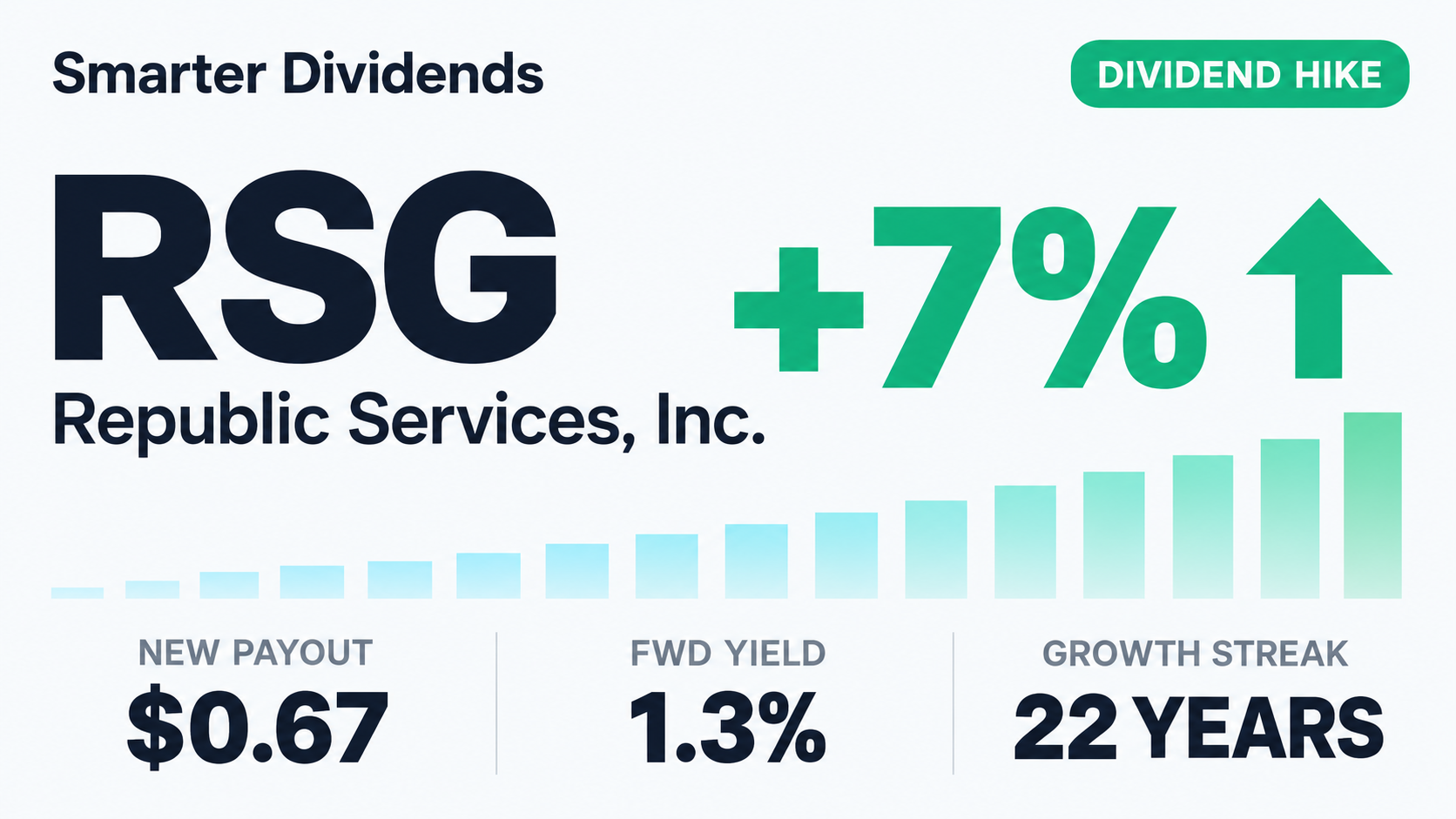
Republic Services Raises Quarterly Dividend 7.2% to $0.67
Republic Services raised its quarterly dividend 7.2% to $0.67, extending a 22-year growth streak as its stronger 2026 cash-flow outlook supports coverage.
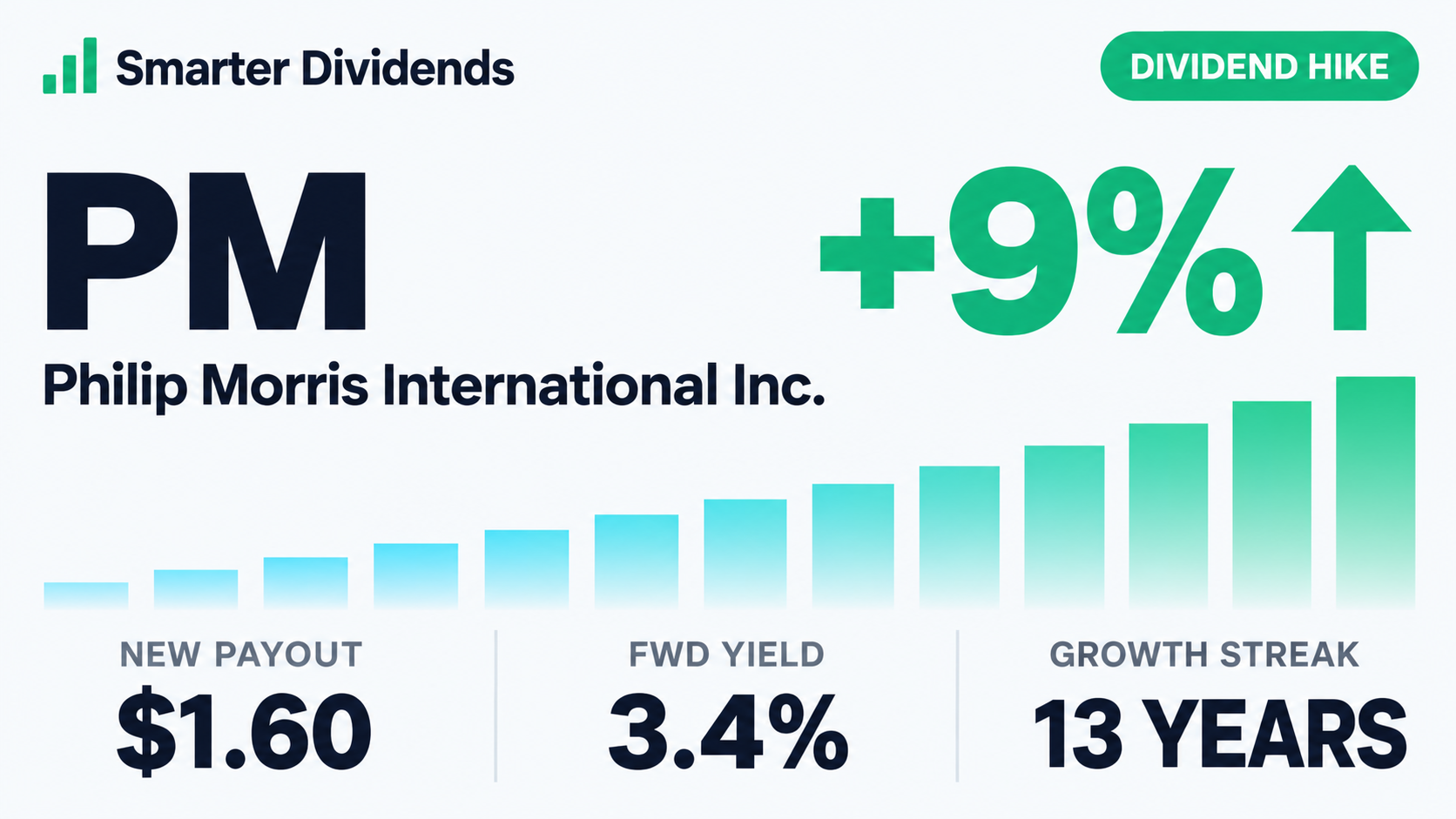
Philip Morris Raises Quarterly Dividend 8.8% to $1.60
Philip Morris lifted its quarterly payout 8.8% to $1.60, extending its annual growth record as earnings and cash-flow guidance support coverage.

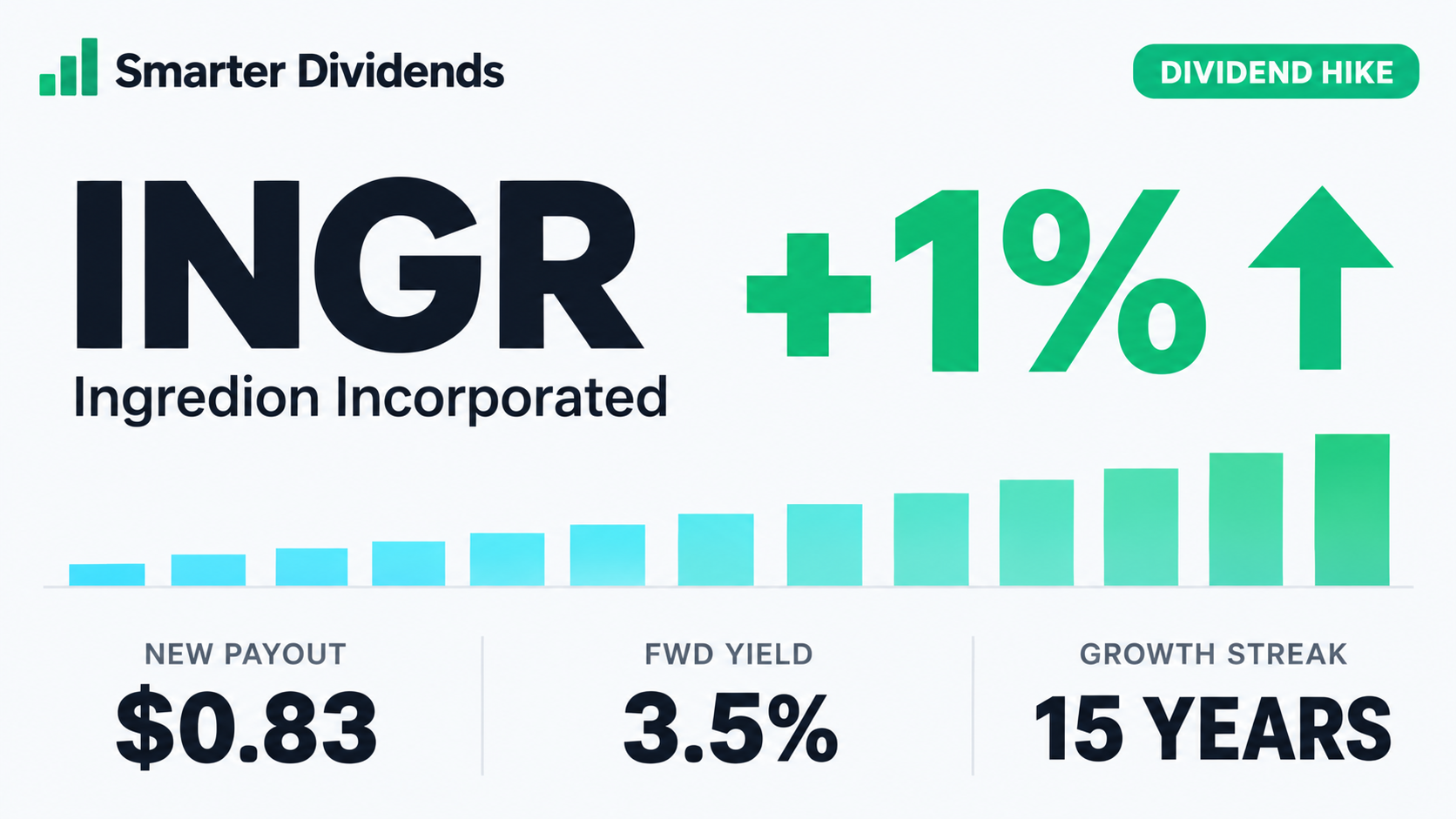
Ingredion Raises Quarterly Dividend 1.2% to $0.83
Ingredion lifted its quarterly dividend 1.2% to $0.83, extending a 15-year growth streak as earnings coverage remains strong despite operating pressures.

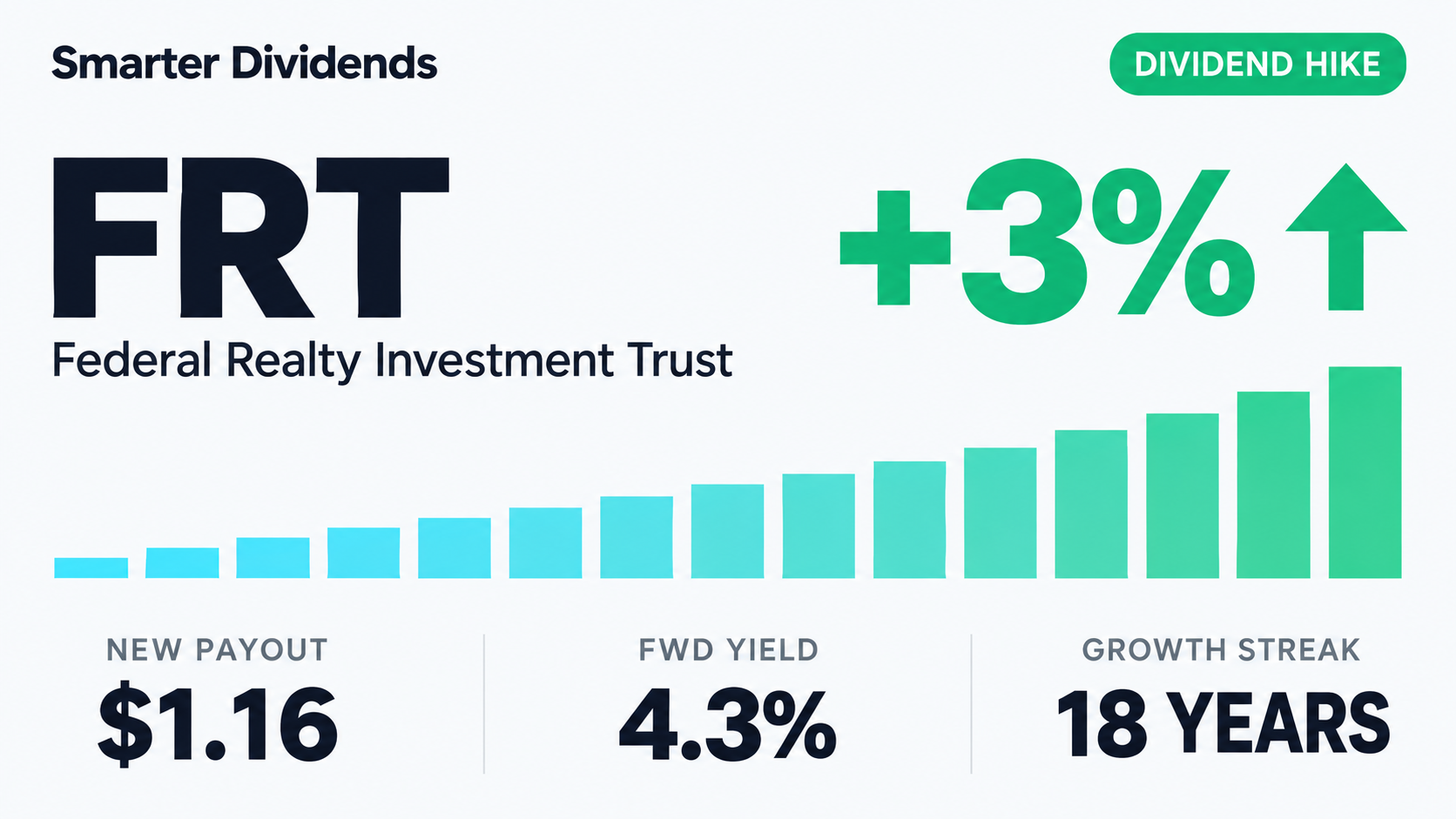
Federal Realty Raises Quarterly Dividend 2.7% to $1.16
Federal Realty lifted its quarterly dividend 2.7% to $1.16, backed by stronger core operations, raised guidance and a long record of increases.

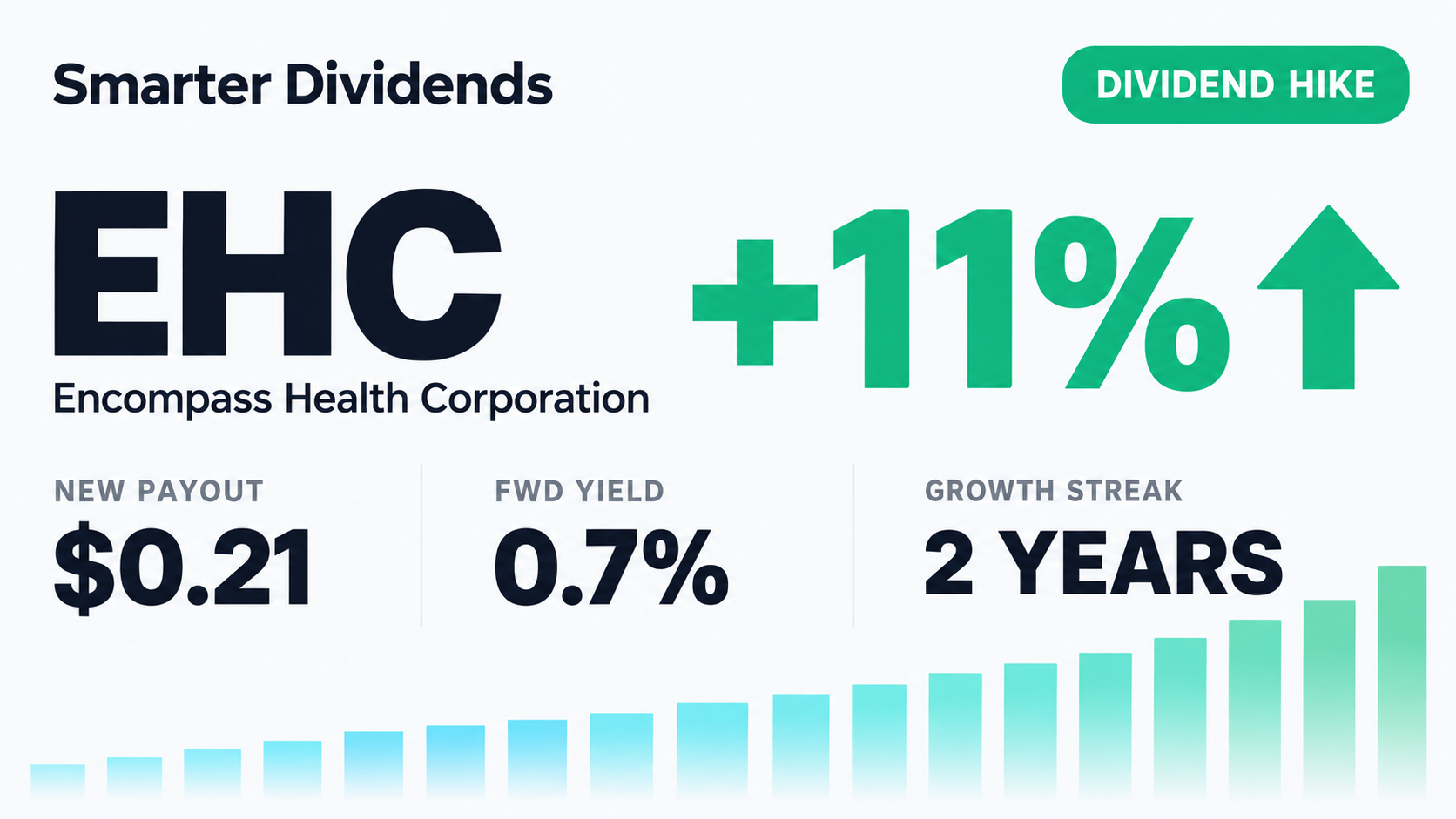
Encompass Health Raises Quarterly Dividend 10.5% to $0.21
Encompass Health raised its quarterly dividend 10.5% to $0.21 as earnings coverage remained wide, though its 0.69% yield trailed healthcare.